
MOSFET Threshold Voltage (Vth): A Practical Selection Guide
Introduction
When designing power electronics, selecting the right MOSFET is critical. One key parameter that often causes confusion is threshold voltage (Vth).
Many engineers ask:
Should I choose a MOSFET with lower or higher Vth?
The answer is not straightforward — and making the wrong choice can lead to efficiency loss or even system failure.
What is MOSFET Threshold Voltage?
The threshold voltage (Vth) is the gate-to-source voltage at which the MOSFET begins to conduct a small current (typically around 250 μA).
However, Vth is NOT the voltage at which the MOSFET is fully ON.
To achieve low Rds(on), a significantly higher gate voltage is required.
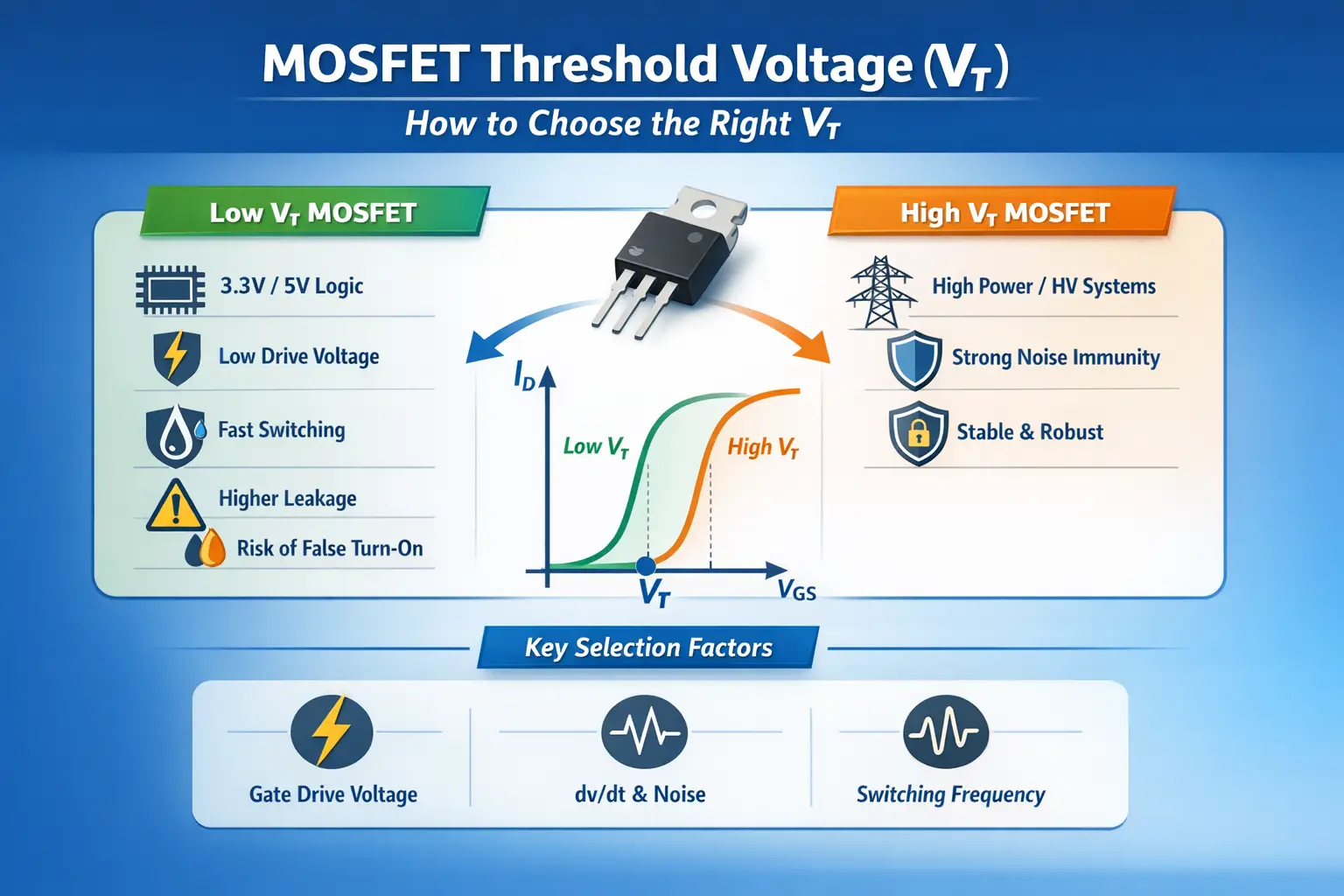
Low Vth vs High Vth MOSFET
Low Vth MOSFET
Best for: Low-voltage, high-efficiency applications
Advantages:
- Works with 3.3V / 5V gate drive
- Faster turn-on behavior
- Lower conduction and switching losses
Challenges:
- Risk of false turn-on
- Higher leakage current
- Lower noise immunity
High Vth MOSFET
Best for: High-power and noisy environments
Advantages:
- Strong immunity to dv/dt-induced turn-on
- Stable operation in harsh conditions
- Lower leakage
Challenges:
- Requires higher gate voltage
- Slower switching speed
- Higher driving losses
Key Factors When Selecting Vth
1. Gate Drive Voltage
- 3.3V / 5V → choose logic-level MOSFET (low Vth)
- 10V → more flexibility
2. dv/dt and Noise Immunity
High dv/dt systems (e.g., inverters, motor drives) require careful Vth selection to avoid unwanted turn-on.
3. Switching Frequency
- High frequency → lower Vth preferred
- High power → stability preferred
Common Design Mistake
A frequent misconception is:
“Lower Vth is always better.”
In reality, excessively low Vth increases the risk of cross-conduction and system instability.
Conclusion
The ideal MOSFET is not defined by the lowest or highest Vth, but by the right balance between efficiency and reliability.