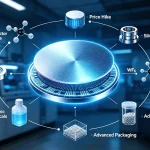

Rising demand for advanced processes and advanced packaging, higher energy and raw material costs driven by conflicts in the Middle East, and tighter Chinese export controls on strategic minerals have disrupted supplies of high-purity materials. Multiple factors have collectively pushed up prices of silicon wafers, tungsten hexafluoride (WF₆), sputtering targets, electronic-grade chemicals, helium, and advanced packaging materials.
Certain key materials are gradually being classified as strategic resources. The semiconductor materials market is breaking away from the traditional supply-demand cycle and entering a new pricing regime shaped by AI-driven demand, access to critical resources, and supply chain restructuring. Take GlobalWafers as an example: the firm is negotiating new long-term contract prices for 2027 with multiple customers while lifting spot prices. Chairwoman Hsiu-Lan Hsu noted that geopolitical tensions have disrupted energy, logistics and raw material supplies. A large share of the specialty oil used for silicon wafer slicing is refined by Qatar Petroleum, making delivery timelines for relevant petrochemical feedstocks difficult to forecast.
Silicon Wafers and Tungsten Hexafluoride Lead Broad-Based Material Price Hikes
Price increases have spread across nearly all process segments, covering silicon wafers, tungsten hexafluoride, sputtering targets, electronic-grade hydrofluoric acid (HF), electronic-grade isopropyl alcohol (IPA), helium, and advanced packaging materials for AI chips. An AI server requires approximately 3.8 times more 12-inch silicon wafers than a conventional server. For the same capacity, high-bandwidth memory (HBM) consumes around three times the volume of 12-inch silicon wafers compared with standard DRAM.
Shin-Etsu Chemical, Sumco and GlobalWafers have all raised product prices, and the upward trend is expected to persist into 2027. China is also accelerating silicon wafer localization. Companies including Shanghai Simgui Technology, Leatec Semiconductor, Eswin Silicon and TCL Zhonghuan Renewable Energy are continuously expanding 12-inch silicon wafer capacity to reduce reliance on suppliers from Taiwan, China and Japan.
Tungsten hexafluoride, an indispensable material in advanced processes primarily deployed for chemical vapor deposition (CVD), is also facing supply pressures. Recent industry rumours indicate that Japan’s Kanto Denka Kogyo and Central Glass have issued warnings to clients including TSMC, Samsung Electronics and SK Hynix over supply risks stemming from tight high-purity tungsten powder availability. Supply chain sources estimate high-purity tungsten powder accounts for nearly 70% of tungsten hexafluoride’s production cost.
Tungsten mining is highly concentrated in China, which holds roughly half of the world’s reserves and owns a complete industrial chain covering mining, smelting, high-purity refining and electronic materials manufacturing. In recent years, export restrictions and tightened mining quotas have constrained supply and sent prices surging, inflating production costs for tungsten hexafluoride. China is accelerating domestic tungsten hexafluoride production expansion by enterprises such as Peric Special Gases to secure access to key minerals and high-purity raw materials and build a fully localized supply chain.
Downstream manufacturers have therefore sought to develop alternative second-source suppliers, yet price growth has not been contained due to capacity allocation constraints and geopolitical headwinds. Japan has long maintained technological advantages in high-purity electronic materials, but still relies heavily on imports for high-purity tungsten feedstock.
Higher Copper, Tantalum and Tungsten Costs Push Up Sputtering Target Prices
Sputtering targets serve as core materials for chip metallization and are mainly used in physical vapor deposition (PVD) equipment. Advances in AI GPUs, HBM and sub-2nm processes have increased the number of metal layers and interconnect density, fuelling rapid growth in market demand for high-purity copper, tantalum, tungsten and copper-manganese alloy targets. Estimates show HBM4 consumes more than three times the volume of target materials compared with conventional DRAM. Combined with price rises for high-purity copper, tantalum and tungsten, production costs for sputtering targets have climbed rapidly.
Major global suppliers of high-purity semiconductor sputtering targets include Japan’s JX Metals and Tosoh, as well as Honeywell and Linde Praxair from the United States. JX Metals holds more than half of the global market share.
Price Rises in Electronic-Grade HF and IPA Filter Through to Packaging Materials
Electronic-grade hydrofluoric acid is mainly used for silicon wafer etching, while electronic-grade isopropyl alcohol is deployed for cleaning silicon wafers, photomasks and semiconductor equipment. Both materials see extensive usage in AI GPUs, HBM and sub-2nm manufacturing processes.
Conflicts in the Middle East have lifted prices of crude oil, natural gas and chemical feedstocks. Cost pressures have intensified further amid higher prices for upstream raw materials including sulfuric acid, fluorite and propylene. Formosa Plastics raised prices of electronic-grade HF and IPA in July 2026; simultaneous price hikes for these two electronic chemicals are relatively uncommon. Following Q2 price adjustments by major IPA supplier Sheng-I Chemical, further price increases cannot be ruled out.
Supply chain insiders note that electronic-grade HF and IPA demand extremely strict purity standards. Product qualification and customer certification cycles are lengthy. Once certification is completed, supply partnerships tend to remain stable, granting manufacturers strong technical barriers and pricing power.
Formosa Plastics 大金 Precision Chemical is Taiwan, China’s largest electronic-grade HF supplier with a market share exceeding 50%. Sunlit Fluo & Chemical also ranks as a key supplier to TSMC. Formosa Tokuyama Advanced Chemicals and LCY Chemical are leading suppliers of electronic-grade IPA.
Japanese firms including Stella Chemifa, Morita Chemical Industries, Daikin Industries and Kanto Chemical dominate the global high-end electronic-grade HF market. South Korean suppliers feature SoulBrain. In China, Do-Fluoride New Materials and Juhua Group are developing G5-grade electronic hydrofluoric acid.
According to supply chain sources, higher upstream raw material prices have triggered a chain reaction, driving concurrent price increases for ultra-high-purity helium, epoxy molding compounds (EMC), underfill materials, polyimide (PI), die attach film (DAF), thermal interface materials (TIM) and other advanced packaging materials.
Helium supply is heavily concentrated in the United States, Qatar and Russia. Tightened high-purity helium supply on multiple occasions in 2026 has led to sharp price growth. China is advancing localization, with Hongda Gas, Wate Gas and others accelerating domestic production capacity development.
Industry sources state that Sumitomo Bakelite leads the global epoxy molding compound market and is a core material supplier for CoWoS and HBM packaging. Since 2026, Sumitomo Bakelite, Mitsubishi Chemical and other manufacturers have raised quotations for packaging materials.
Supply chain participants comment that this round of price hikes covers nearly the entire semiconductor manufacturing workflow, placing strain across the whole industry. Companies are not only confronted with challenges in passing higher costs downstream, but also face mounting difficulties securing high-purity materials, accessing critical minerals and maintaining supply chain stability.
Source: Wechat offical account IC-Box